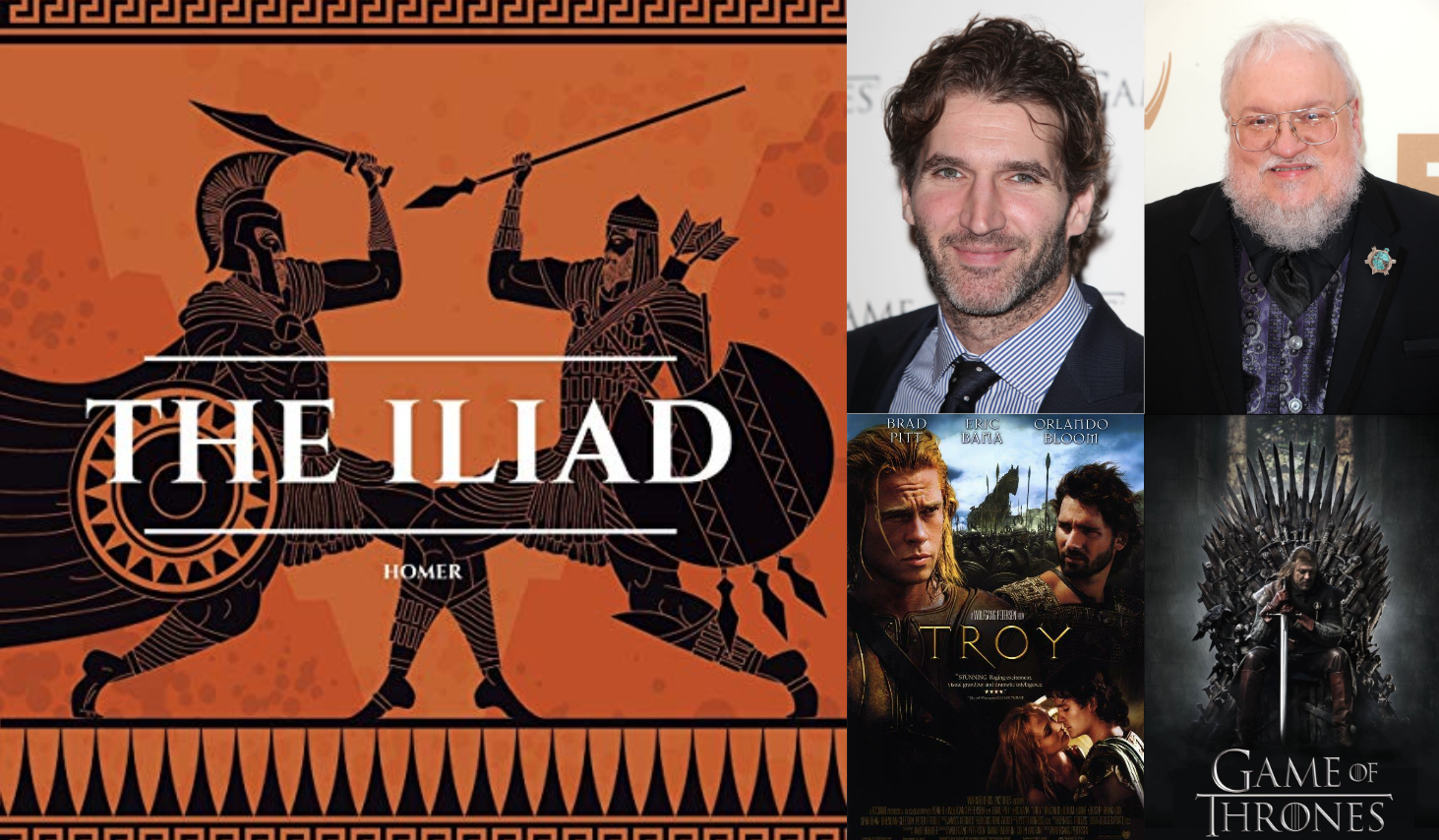

In Part 1 of Iliad, Ice and Fire, we explored the Influence of The Iliad on David Benioff, George R.R. Martin, Troy and Game of Thrones by examining parallels between ideas, events, and storylines. Additional parallels can be drawn by exploring concepts that underlie important themes in Greek literature generally and The Iliad specifically. The concepts of Aristeia, Kleos, and Timé relate to glory and honor and how they are achieved and expressed. These themes are at the core of The Iliad and are captured and expressed throughout Troy and Game of Thrones.

ARISTEIA
In Greek mythology, Aristeia refers to a moment or scene of awe inspiring bravery displayed by a hero in battle as he slays enemies and dominates the battlefield, often shifting momentum to bring glory for the hero and victory for his army.
In The Iliad, a warrior named Diomedes is infused with special powers by the goddess Athena and, in an extended sequence, displays god-like skill in battle as he cuts down Trojan ranks, attacks prominent Trojan warriors, and even wounds Ares, the God of War himself. Though lesser known in pop-culture, Diomedes performs one of the longest battle sequences in The Iliad and demonstrates the combat skill, fearlessness, and conquests that typify the concept of Aristeia.
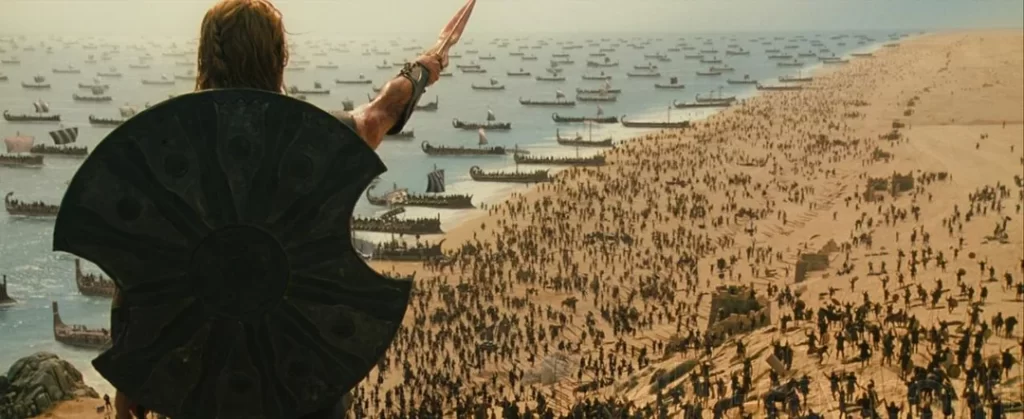
The more universally known warrior Achilles also has a lengthy Aristeia in The Iliad and is presented in a similar context in the movie Troy, which is primarily based on The Iliad. The most famous Aristeia in The Iliad is generally recognized to be Achilles’ rampage after learning about the death of his friend (and yes, cousin) Patroclus during which Achilles, in a state of rage compared to a wildfire, kills dozens of Trojan soldiers. While these extended scenes are omitted in Troy (which instead presents the Patroclus death fury of Achilles as solely directed against Hector), the movie showcases Aristeia when Achilles and his Myrmidons storm the Trojan beach and Achilles, seemingly alone, almost effortlessly slays soldier after soldier to vanquish the Trojan defenses and establish a position on the beach.
As with many classic concepts from Greek mythology, Aristeia is present in multiple scenes in Game of Thrones. For viewers of the prequel series House of the Dragon, a clear example of Aristeia occurred when Daemon Targaryen, after feigning surrender at the Stepstones, burst into a frenzy of violence that demonstrated his battlefield prowess and bravery as he turned the tide of the conflict and slew the Crabfeeder.
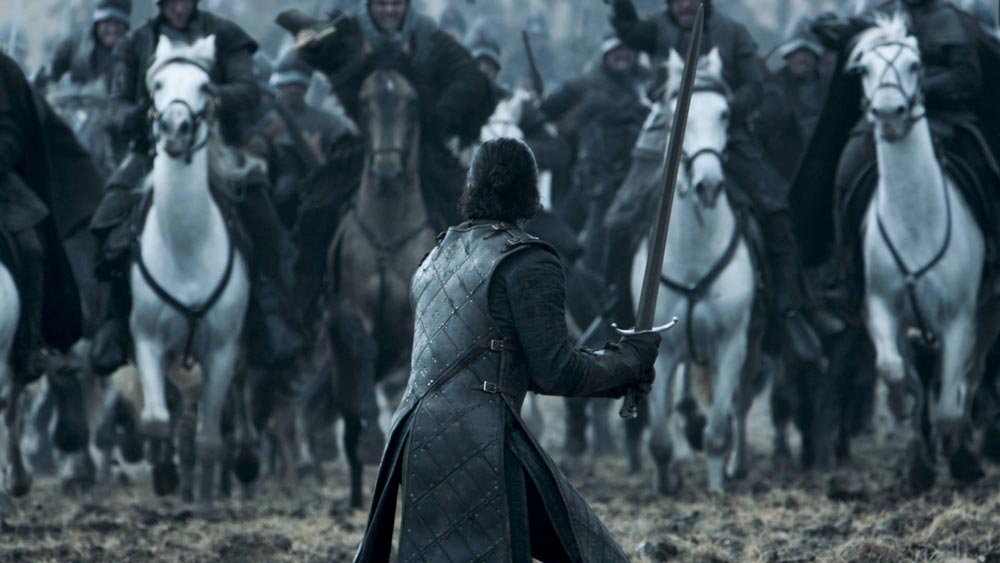
But arguably the most iconic visual example of Aristeia in Game of Thrones is Jon Snow at The Battle of the Bastards. While he led a number of battles throughout the series during which he displayed the elements of Aristeia, at The Battle of the Bastards, Jon, whose army was outnumbered, outpositioned and faced almost insurmountable odds against the forces of Ramsay Bolton, drew his sword, led the charge and, for a moment, stood alone as the perfect illustration of glory and heroism – an unforgettable image of Aristeia.
KLEOS
While several examples of Aristeia are identifiable in The Iliad, Troy, and Game of Thrones, the concept of Kleos is featured more prominently and extensively throughout all three works. Kleos at its essence is glory earned through great deeds that brings fame, honor, and respect to the hero during his life but, also is glory that continues beyond death as his immortal legacy which is recognized and celebrated in songs and stories. So important is Kleos to potential heroes that its attainment can be a strong motivating factor in deciding which battles and quests to pursue. In The Iliad, it is explicitly stated that Achilles is not only motivated by Kleos, but that it serves as the primary factor in his decision to continue participating in the Trojan War. Achilles openly contemplates two futures: one is to enjoy a long life in relative obscurity and the other is to die young fighting the Trojans but be rewarded with everlasting fame. Achilles, in choosing the latter, values his legacy more than his life, demonstrating the importance and power of Kleos.
The movie Troy makes this choice explicit in a scene when Achilles speaks with his mother Thetis about his decision. The mother of Achilles tells him that he could abandon the war and have a peaceful life with children and grandchildren who will remember him, but that his name will fade over time. Alternatively, if he joins the war, Thetis implies he will die in battle but states “glory will be yours” and “the world will remember your name” which is the very nature of Kleos. To put a finer point on the dilemma and highlight Kleos as an aspiration that can supersede life itself, Thetis tells Achilles, “Your glory walks, hand in hand with your doom.”
Throughout Troy the concept of Kleos is repeatedly referred to in dialogue and is continuously cited directly by Achilles as his driving force. In the opening scene of Troy, Odysseus as narrator asks the question “will our actions echo across the centuries? Will strangers hear our names long after we are gone, and wonder who we were…”. And in the very first scene with dialogue, Achilles is being assisted by a young boy who expresses fear about confronting a Thessalonian warrior to which Achilles replies “that’s why no one will remember your name” making clear his fixation on Kleos as well as defining the relationship between bravery in battle and being remembered.
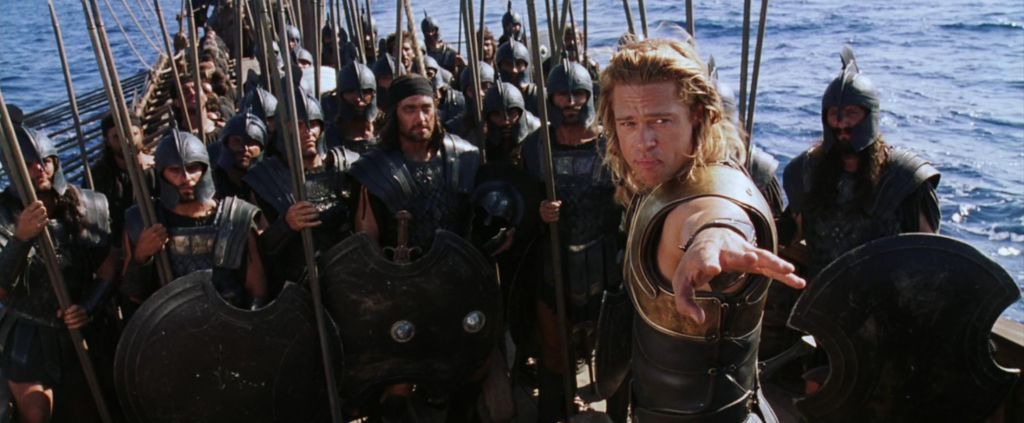
Kleos is frequently leveraged as a powerful incentive for warriors to participate in battle. When Odysseus (played by Sean Bean) seeks to convince Achilles to fight in the Trojan War, it isn’t land or treasure that he promises, it is Kleos: “Think how many songs they will sing in your honor…. This war will never be forgotten nor will the heroes who fight in it.” Later as Achilles and his Myrmidons storm the Trojan beach, Achilles shouts to his forces “What is waiting beyond the beach…[is] immortality!” again both defining Kleos and leveraging it to inspire his fellow warriors.
Troy is replete with open references to Kleos so it’s not surprising that its screenwriter David Benioff, who is well versed in the lore and themes of Greek Mythology, infused the concept into Game of Thrones when he created the series. Whether it’s long dead warriors in Westerosi history like Prince Rhaegar or Ser Arthur Dayne whose legends we learn about through exposition, or Season 1 characters like Barristan Selmy and Robert Baratheon swapping tales of great battle victories, the notion that valor earns one a place in history makes an early appearance in Game of Thrones.
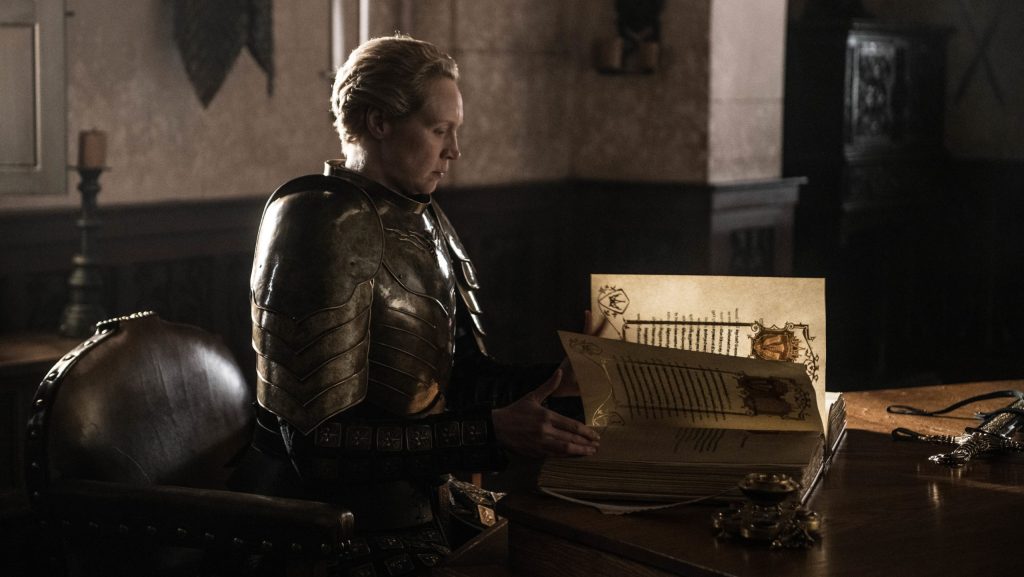
But Kleos is perhaps most persistently bound throughout the series to Jaime Lannister whose place in history is often questioned and derided as he contemplates his identity and values. Despite his renowned swordsmanship, King Robert Baratheon mocked Jaime as a “glorified sentry”. Jaime’s own father, in a scene that clearly has Jaime agonizing over his role in the world, belittled him as a “glorified bodyguard” and accused him of being overly fixated on what other people think of him. While Kleos is a concept (as described above) it can also be loosely translated to “what others hear about you,” which is specifically what Jaime, despite his denials, is concerned about. He is clearly pained in Season 4 when Joffrey notes the lack of Jaime’s “great deeds” recorded in the White Book, a history of every member of the Kingsguard. Jaime later tells Brienne of Tarth, who notes his sparse entry, “there’s still room left”, further establishing his interest in how he will be remembered through the ages. It is fitting that Jaime’s legacy (Kleos) is preserved in the still vastly underappreciated series finale when Brienne returns to the White Book and chronicles numerous acts of valor by Jaime.
TIMÉ
Timé which means “value” is a form of honor or recognition for accomplishment. But rather than the type of honor that might be demonstrated in an admirable act or standard of conduct, Timé is often represented by material possessions that serve as physical symbols of achievements, such as the spoils of war, that inspire respect by observers.
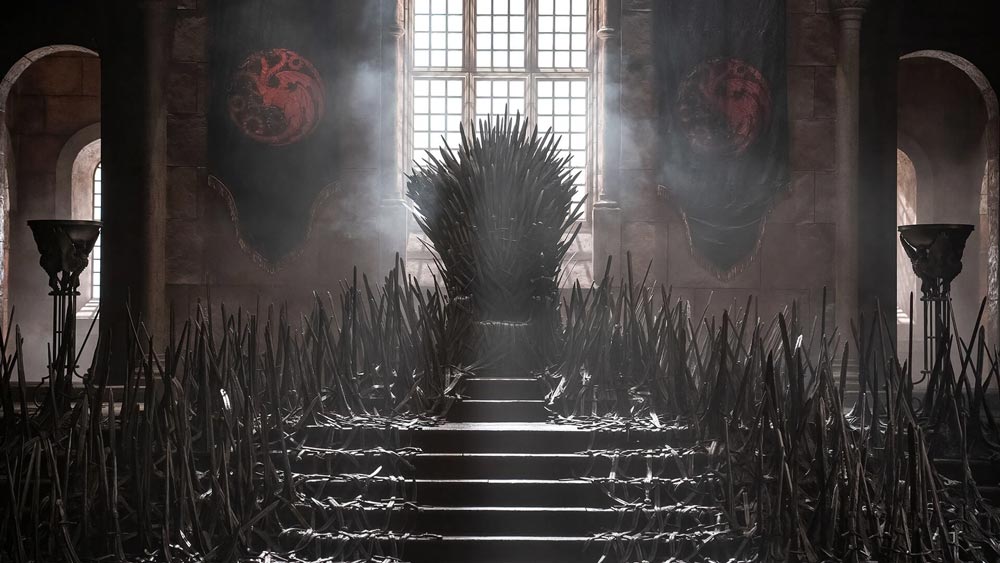
A clear example of this theme in The Iliad features a warrior saying to another: “Spears you’ll find inside arrayed against the bright wall of the entranceway… I win weapons from the dead.” The capture and prominent display of weapons from defeated foes conveys honor and commands respect since these weapons are not merely spoils, but are physical representations of the battle bravery that led to their capture. The Iron Throne itself is a powerful example of Timé since, aside from being the literal seat of power, it is a massive collection of weapons won from dead enemies that symbolize the battles fought and the esteem commanded by he who sits the throne. Another example of Timé in Game of Thrones is Tywin Lannister taking possession of and reforging Ice, which is the ancestral Valyrian steel sword of House Stark.
But Timé can extend beyond weapons and treasure and be in the form of people won in war including women and slaves. The subject of women as the spoils of war and the Timé associated with them plays a key role in major plot points in The Iliad and Game of Thrones and links major characters in the stories through events and the above themes, which we’ll discuss in a forthcoming article Iliad, Ice and Fire Part 3.



Comments (0)